Directional Drilling in Durham & Chapel Hill
The Bull City sits inside an ancient rift — a buried basin of red mudstone left by the continent's breakup — with the nation's largest research park at its edge, two universities running world medicine, and a boundary fault where the ground changes in a single block. Western Triangle HDD is basin drilling in a research capital — and it's ours.
HDD is the whole job here
The western Triangle drills inside a piece of the continent's breakup: when the Atlantic began to open, rift valleys tore the piedmont, and one of them — filled with red mudstones, siltstones, and sandstones, then buried and beveled flat — lies directly beneath Durham, Chapel Hill's eastern edge, and Chatham's rising towns. Basin ground is its own trade: the red rock drills fast, but it slakes and softens on exposure, cuts to a slick that tests fluid programs, and hides the basin's hard punctuation — diabase sheets and stringers, the dense black igneous bodies mapped through the rift fill, arriving as sudden rock inside soft rock. And the basin has an edge: the boundary fault runs the western line, and across it the ground flips wholesale to the piedmont's weathered crystalline story — deep red saprolite over granite and gneiss. Basin-and-boundary quoting names which world your alignment crosses, checks the mapped sheets, and states the terms for the unmapped ones.
The market is the research economy at full concentration: the nation's largest research park spans the county line with its campuses, labs, and the redevelopment wave rebuilding its core; two universities run world-rank medicine a few miles apart — the Bull City's and the college town's hospital systems both building continuously; and downtown Durham's brick-and-beam blocks — the tobacco warehouses reborn as offices, labs, and the ballpark's district — carry an adaptive-reuse economy with heritage-brick manners. Chatham's south rises at a different register entirely: the mega-development at Pittsboro's edge and the auto campus rising at Moncure pull utility programs across a county the maps still call rural, while Person's power-plant country and Granville's corridor towns round the metro's quieter north.
The waters run under watershed law: Jordan Lake — the Corps reservoir that supplies much of the region — anchors the south with its famous nutrient rules, Falls Lake's watershed clips the county's north with rules of its own, and the Eno winds through Durham under a protected corridor the city genuinely loves. Behind everything sits the network desk — 50,000+ boring calls answered, ~10,000 crossings quoted, 2,000+ drilled — pricing the western Triangle with the basin already in the math.
Fiber-Optic Boring
Park and lab duct, hospital-campus laterals, and FTTH across the basin.
Electrical Duct Boring
Feeders for labs, hospitals, and a metro building in every direction.
Water & Force-Main Boring
Pressure pipe under the strictest watershed law in the state.
Jordan Lake & Eno Crossings
The signature Triangle bore: the supply reservoir's world and the city's beloved river.
Road & Highway Crossings
The Bull City's streets, the freeway ring, and the state's rural miles — basin-named, priced honestly.
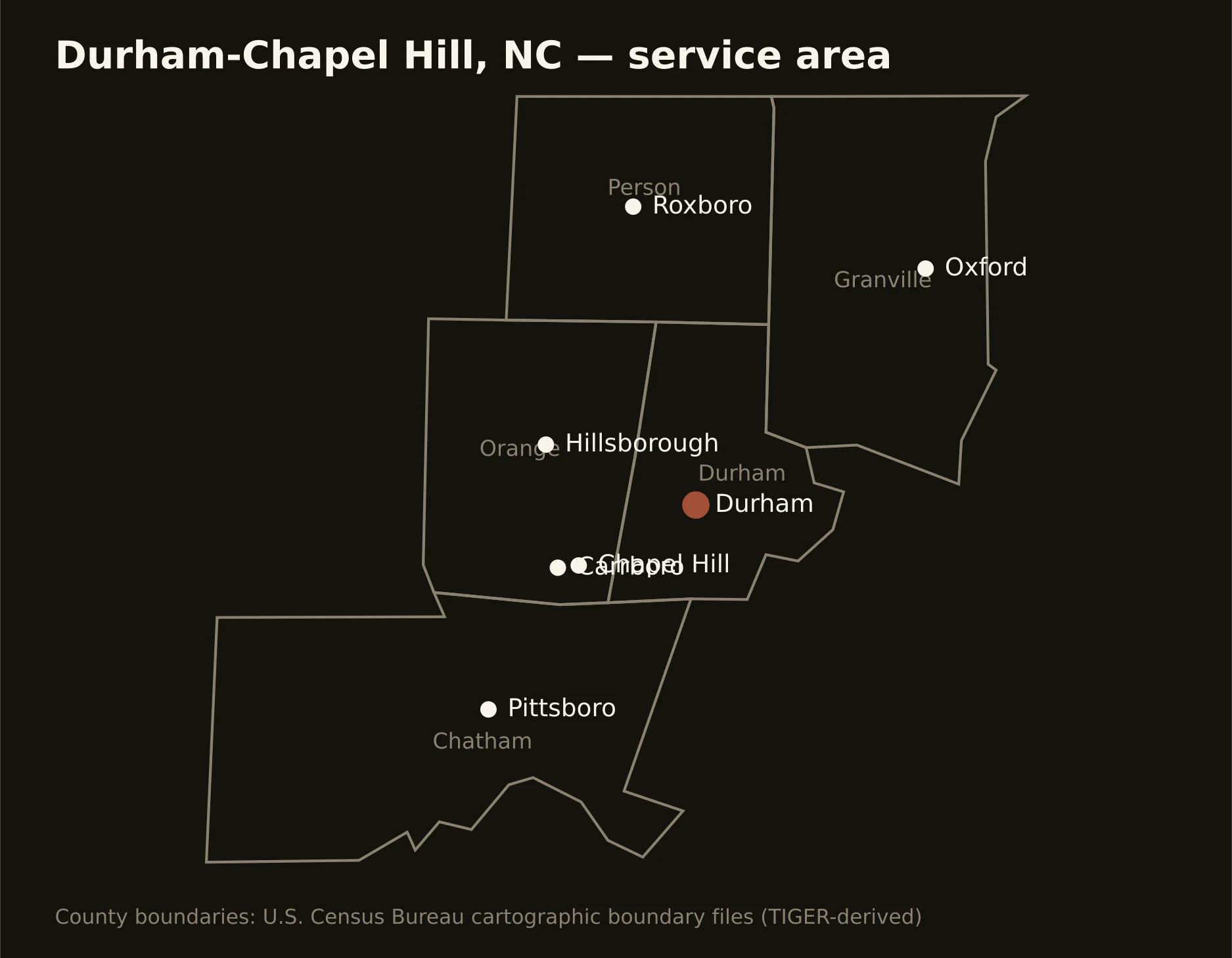
Five counties around the basin — Durham with the Bull City and the park, Orange carrying Chapel Hill and Hillsborough, Chatham rising fast at the basin's south, and Person and Granville rolling the crystalline north. Full county list on the service-area page.